
 The Video Games
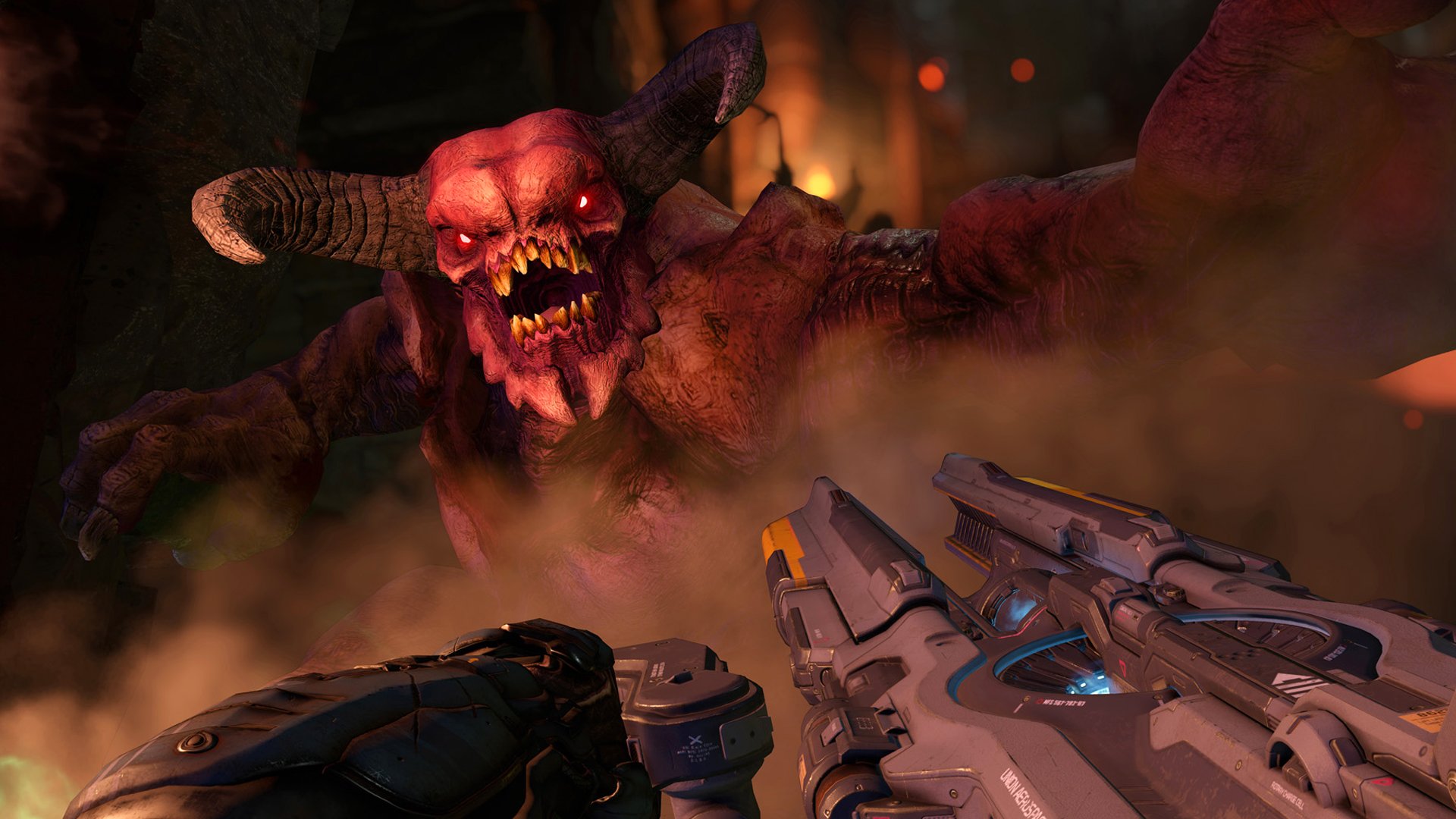

The name Doom means so much to so many gamers. For some, it was their first introduction to gripping FPS action, with all its palpable weapon feedback, terrifying enemies, intricate environments, and gratuitous gore. For others, it opened up the gates to the thrills of player-vs-player deathmatch, or cooperative demon slaying across the wastelands of Hell. But whether or not you’ve played the original games, this new vision of Doom is undeniably exciting. It’s just as savage, speedy, and smart as its predecessors, with all the glorious presentation and polish that only a big-budget game can deliver.
Ever since its explosive debut at E3 2015, we’ve gotten some extensive hands-on time with Doom at Quakecon and beyond, and we can talk about the alpha test footage shown off by id software itself. This is a reboot that goes beyond mere nostalgia – it looks to reinvigorate what you loved from the originals, adding in fresh ideas and ludicrous amounts of mobility. Here’s everything you need to know about Doom before it comes to PS4, Xbox One, and PC sometime in Spring 2016.

It’s fast, it’s ferocious, and it never, ever stops moving. From the industrial environs of Mars, to the wide, open-air killing fields of Hell, Doom’s combat is a whirling, ever-shifting carnival of weapon-changing, demon-mulching violence. As in the original, you never have to reload, and you’re always running at a full sprint, no extra button presses necessary. On top of his expected speed, Doomguy also has a neat new mantle move, which, alongside his double-jump, opens up a raft of verticality and on-the-fly strategic options.
What you can’t do in Doom is crouch – that’s strictly for cowards. Instead of hiding behind crates, you’ll be climbing and vaulting off them to retaliate against your attackers with a surprise shotgun burst as you hurtle through the air. And you’ll really never have a reason to drop everything and hunker down for cover, because…

Too long have we been coddled by Call of Duty’s invisible health pools. We’ve been conditioned to to scramble behind something when our vision turns red, then sit motionless while we wait to magically regain full HP before charging back into the fight. But Doom’s breakneck pace simply wouldn’t allow for such dull bits of downtime, so it’s relegating your recovery to those classic FPS standbys: health packs and armor pick-ups.
Instead of injuries forcing you to come to a standstill, they’ll give you that much more of a reason to keep barreling around the level, scooping up as many revitalizing items as possible (and in multiplayer, memorizing their locations for later). Alternatively, you can regain health by eviscerating every demon in sight, given how medkits (and ammo) spill out of demons’ innards like sugary candy from bloody pinatas.

It simply wouldn’t be Doom without the Super Shotgun and its demon-shredding discharge of hot lead. That trusty double-barreled boomstick is back, along with other traditional FPS armaments like the Rocket Launcher and the Plasma Rifle, which evoke nostalgia and dole out destruction with equal potency. When you want to eviscerate your enemies up close, it’s time to whip out the chainsaw. And of course, when you absolutely need something dead, there’s always the BFG9000. But these weapons aren’t exactly like you remember them in the original games.
In a design move similar to classic Unreal Tournament, each gun has two modes of fire. There’s the primary fire you’re used to, mapped to the trusty right trigger – but those are complemented by Weapon Modifiers on the left trigger, which can completely change the way you use your artillery. Some Modifiers are fairly simple, like aiming down the sights of the Repeater battle rifle (more on those in a sec). But others add a new dimension of utility to your weapon, like the Rocket Launcher being able to instantly detonate all its mid-air missiles, the Super Shotgun’s ability to blast bullets in a tighter spread, or the Plasma Rifle lobbing out an orb for area damage.

This is probably the only bit of the new Doom that’ll make old-school diehards fidget uncomfortably, if only for a moment. Change can be scary, and Doom’s arsenal has some unfamiliar newcomers along with the old favorites. The aforementioned Repeater fires in three-round bursts, similar to Halo’s almighty Battle Rifle. The powerful Railgun, an absolute staple of Quake 3 Arena, isn’t here, replaced by two similar weapons: the Vortex Rifle, which can snipe from long range and charges up in power when scoped, and the Gauss Cannon, a multiplayer-only launcher that’s a guaranteed one-hit kill.
But you should embrace these new weapons, as they’ll force you to adapt to fresh forms of combat and open up even more demon- and/or player-murdering possibilities. They might even become your new favorites – particularly the ironically named Static Cannon, which increases in power when you’re constantly in motion. There’s also additional utility to be found in Equipment, such as frag grenades and the return of Personal Teleporters (which inevitably give way to glorious Telefrags). These handy items are now mapped to L1/LB, so you won’t have to put away your weapon just to toss a grenade (unlike in Doom 3).

Most AAA games these days need a motivation deeper than ‘Uh oh, shoot those monsters before they kill you’, even Doom. But with any luck, you’ll never have to stop gunning down hellspawn to watch a cutscene or listen to Doomguy’s heartfelt inner monologues. There are some echoes of Doom 3 in what we know of the plot: a demonic portal opening in a UAC (Union Aerospace Corporation) facility on Mars, brought on by brilliant scientists turned fanatical cultists. But the story elements will definitely be more of a ‘there if you want it’ deal in the new Doom.
The backstory behind the literal Hell unleashed on Mars is meant to be pieced together through environmental storytelling and data logs scattered around the facility, rather than explicitly presented to you in a set progression. Occasionally, you’ll even get first-hand glimpses of the horrific events that transpired before your arrival, courtesy of room-projected holograms called Echoes. Those poor scientists should know that hitting the ‘Record’ button probably means they’re going to die screaming within the next minute or so, probably at the hands of a hulking Baron of Hell.

Here’s a new one: this Doom will see your space marine beefing himself and his arsenal up over time. As you explore the UAC base, the surface of Mars, and the blood pits of Hell itself, you’ll earn upgrades by slaying elite demons or discovering treasures (and weapon modifiers) stashed around the environment. Some are simple buffs to your survivability, such as increasing your total health or letting you pick up more armor and ammo. Weapon mods can add small boosts to your slugs, like adding a brief stun effect to the Plasma Rifle’s energy shots.
But what’s more interesting (and fresh for the series) are runes, which tweak your abilities in ways that will directly affect gameplay. Maybe they’ll imbue you with the power to trigger execution moves more quickly, or provide a speed boost any time you swap weapons. Once discovered, you’ll be able to mix and match between these runes at any time, allowing you to prep for particularly brutal encounters with a specialized loadout.

Doom and Quake share much of the same aesthetic and gameplay DNA, given that they represent id software at peak form. So it makes sense that the new Doom’s multiplayer would adhere to the same tenets as the legendary deathmatches of the blazingly fast Quake 3 Arena, rather than the simplistic shootouts of classic Doom LAN play. From what we’ve played of the 6v6 multiplayer, these team deathmatches are just as gloriously overwhelming as you remember.
Fans will appreciate the return of classic, tide-turning power-ups like Invincibility and the almighty Quad Damage, and the pop-up damage numbers from Quake Live help newcomers get a sense of which weapons are the most effective at any given range. But there are some surprising additions, from minor – like selecting a two-weapon loadout before spawning in – to absolutely major. That would be the pentagram power-up that lets you transform into a demon, including the rocket-shouldered skeleton known as the Revenant. Morph into this monstrosity, and you’ll be able to rain down rockets from the air and zip around the map using your backbone-fused jetpacks. But it’s not a killing spree guarantee – marines have much more health than what you’re probably accustomed to, turning most firefights into tense cat-and-mouse games of hit-and-run tactics before you can secure the kill.

The original Doom didn’t even allow your space marine to jump, which was just fine – most of the levels were only one or two stories tall, with plenty of large-scale fights on flat land. And while the new Doom’s level designs still mimic the visual style of the original games, they put more more emphasis on your upward mobility. With Doomguy now able to double-jump and catapult through the air, stages are designed with plenty of layers and set pieces to vault from in the pursuit of higher vantage points. The multiplayer maps even bring back the gravity-mocking jump pads from Quake 3 Arena.
Thematically, they’ll be just as much variety here as in previous Doom games. The UAC facility feels very sterile (save for the blood and guts everywhere) and claustrophobic, while the nightmarish wastelands of Hell give you plenty of room to sprint around while being chased by a conga line of Imps. You should probably prepare yourself for some rather old-school structuring, where you might have to double-back around a level looking for the appropriate color-coded keycard before you can move on.

Doom has an immense history with the modding scene. The original game, with its easy-to-tweak file system, is pretty much responsible for modding being a thing in the first place. And with the SnapMap tool, user-made content won’t just be restricted to the PC platform. Like Halo’s Forge, the SnapMap mode in the new Doom gives you the kind of godlike power to create a level to your exact specifications, no programming or 3D mapping experience necessary.
This is more than just a Lego set of pre-constructed pieces and cookie-cutter layouts linked together, though you can stick to those when you’re first getting started (which is easy, thanks to included tutorials). You can get as granular as you like here, adding environmental triggers, tweaking enemy AI, and alter any variable as you see fit. Like LittleBigPlanet, it’s creative freedom to the point that you can craft the kinds of experiences that don’t even resemble the base game. These custom creations can be shared worldwide on the SmartHub, a vault of player-made maps that should help curate submissions so that the cream rises to the top.

Taking the occasional hint from Doom 3’s more ‘realistic’ monsters, but swinging far closer to the early games’ more colorful, expressive take on biotech body-horror, the new Doom’s demons are a totally faithful, modern recreation of the same, deceptively clever line-up of enemies that have underpinned the series – and in fact FPS archytypes in general – for over 20 years.
Zombieman is in. Imps are in. Pinky Demons are in (and returning as the chunky, bipedal melee-bastards we all know and love, rather than the wheel-assisted rhino-dog of Doom 3). Barons of Hell are back, as are Mancubi, Revenants, and Cacodemons, all fulfilling the same roles and behaviors they’re supposed to in Doom’s complex, quietly cerebral ecosystem. These horrors typically spawn out of gruesome flesh portals known as Gore Nests, some of which will have to be closed using deadly force. And oh yes – mustn’t forget about the Cyberdemon, lest he vaporize us with his colossal arm cannon or rip and tear our limbs off with those gnarly, sharp teeth.

File this one under ‘Don’t-you-dare-screw-with-Doom’s-core-gameplay-Oh-actually-hang-on-yeah-let’s-have-that-new-bit-actually-because-oh-my-God-it’s-incredible’. While the new Doom is entirely, spiritually authentic to the fast, furious, freewheeling open combat that Doom Just Is, the new melee execution mechanic – appropriately named the Glory Kill – is an incredibly exciting addition. It’s new, it’s fresh, it transforms things just enough to make Doom feel unique again, but crucially, it’s so well implemented that it feels like it was always there.
Do enough damage to an enemy without completely killing them, and they’ll start to glow. Get in close before they recover, and you can fire off a hilariously, triumphantly violent hand-to-hand takedown, the kind of thing that makes the earlier games’ Berserk power-up look tame. Heads are twisted off. Jaws are wrenched away from heads. Entire limbs are snapped off and used to stove in any heads that may miraculously remain intact. It’s the kind of gore that would be intolerable if you were killing humans – but these are demons from the pits of Hell, so it’s all good. And being delivered by Doomguy, these ‘little’ takedowns, however intricate, happen fast and furiously enough to never, ever slow down the pace of the combat.

If you’ve seen your fair share of viral game parodies, you’re probably familiar with the heavily modified mockery of ‘If Doom was done today‘, which shoehorns the beloved game into all the tropes made popular by Call of Duty. And here’s the thing: thanks to some leaks, we now know that this reboot used to actually be ‘Call of Doom’ in all but name.
Instead of the classic scenario of a one-man army against a demon outbreak on Mars, this Doom would’ve featured a squad of soldiers resisting the forces of Hell on the post-apocalyptic city streets of Earth. Fortunately, the team at id software felt like it just didn’t match the personality of the Doom franchise, and started the whole game over from scratch. That definitely looks like it was the right move, though the old assets are nowhere near as cringe-worthy as the scrapped FMV scenes from the 3DO port of the original Doom.



GIPHY App Key not set. Please check settings